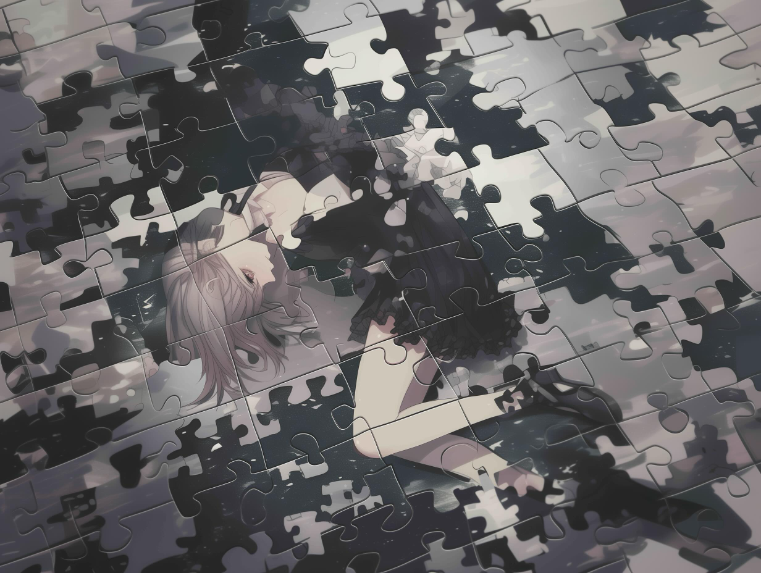
A senior classmate of mine worked at a café and said it was a good spot — quiet, good for reading and writing. I had nothing to do during the day, so I tried it. The café also had lots of jigsaw puzzles to pass the time. I’ve had a fear of jigsaw puzzles since childhood — the sight of those jagged cut lines makes me uncomfortable. But they were the café’s thing, and refusing outright would be unsociable.
I started doing one just to seem polite, intending to put together a few pieces and leave it at that — but I kept going without realising. The image was a Disney animated film I’d seen as a child, the lead character a beautiful ice princess. For some reason, looking at that half-assembled face on the verge of fragmenting set off a panic attack.
After that, I started seeing jigsaw cut lines overlaid on everything in front of me — that irregular interlocking texture. At first it came and went in a flash, and I assumed it was my eyes. Later it happened whenever my gaze settled or I stared into space, disappearing again as soon as I moved. These irregular grids were frustrating, like something blocking my vision that I couldn’t brush away. True to my habit of avoiding things, I tried to pretend it wasn’t happening.
When I woke up one morning to find the bathroom mirror covered in jigsaw lines, I wasn’t that shocked. Maybe because I wasn’t fully awake yet, I unconsciously reached out and tried to lift off one of the puzzle pieces in the reflection. I pulled away the piece containing my right eye — and was startled to see an irregular gap where it had been. I let go; the piece with the eye on it fell into the sink. Frightened but unbearably curious, I kept going, until the entire face had crumbled away in pieces and the sink was full of fragments. I stared at the hollow face-shaped void in the mirror, then finally turned and ran.
Like someone who can’t stop picking at a scab, I found myself increasingly unable to resist pulling away the puzzle pieces that floated up before me. On the MTR I’d unconsciously dismantle the crowded carriage; at a restaurant I’d remove a noisy table of neighbours; I’d tear ugly community posters out of my field of vision. I found that removing certain things made the world more bearable, even if it left behind gaps with jagged, uneven edges. One advantage of a jigsaw world.
You have to be subtle about it, though — do it too obviously and people give you suspicious looks. Once, a senior classmate who’d been pestering me about a favour dragged me out for a meal I didn’t want to attend. He held court the whole time while I drifted off, and without noticing, I started lifting away piece after piece from the scene in front of me until the man looked as if he’d been cut out of the picture — a slightly sunken void. What is a void? I couldn’t say. Not exactly a cardboard backing; not any describable colour. Just a kind of non-existence. Looking at it, I felt almost peaceful, as if even his voice had been erased. Then I suddenly lost my balance and lurched sideways, nearly falling off my chair. His image snapped back; he grabbed both my hands in alarm. I had an urge to shake him off and shatter his face into pieces, but I didn’t have the energy.
At first I thought randomly dismantling puzzle pieces was harmless. It had no real effect on the world — no actual damage done — and nothing bad happened to me either, except looking strange in public. So I did it more and more, sometimes out of boredom, sometimes out of bad moods, losing control of it entirely. The empty holes grew bigger and more numerous, and eventually they reached a point where the consequences were irreversible.
One time I was crossing the elevated walkway near my home when the visual scene stretching away in perspective suddenly made me feel ill. I froze, and the jigsaw lines immediately appeared. I flailed my arms forward like I was chasing something, and shattered the walkway, the motorway below it, the buildings and hills on either side — all of it into fragments. The pieces fell like rain. But the ground is part of the image too, so where did they land? I genuinely don’t know. Physically, they just fell.
In the end, I found myself in an endless void — no outside, no inside. I’d smashed the phenomenal world, and found there was nothing behind it, and I was trapped inside with no way out. In that moment I panicked more than I ever had; and then, in the very next moment, I felt a calm I’d never felt before. I said to myself: so this is what’s behind the puzzle. That must mean this is the truth. But I couldn’t do nothing — I had to clean up the mess I’d made. I crouched down (with no actual floor beneath me) and began picking up the tiny fragments one by one. I don’t know how long I spent putting the phenomenal world back together. I only know that by the time I was done, the sky was fully dark, and the lit-up walkway stretched out before me. I finally stepped out of the void and dragged my exhausted body home.
Since then I’ve treated the puzzle pieces with more care. The occasional ones I remove, I make sure to put back. I still go often to the café where my senior works, and I can now do the puzzles there easily. She and the owner think I’ve conquered my fear and become a puzzle enthusiast. The truth is: I can’t stand an incomplete image or stray fragments. I have to put everything back where it belongs. Even if those cut lines can never be erased — always announcing the possibility of breaking apart.
The puzzle tells me I have to face my incomplete, constantly fracturing self. I work up the nerve to go into the bathroom, stand at the mirror, and look at the human-shaped void. Roughly counting the mirror’s area, there must be four or five thousand pieces at least. The missing face and upper body — maybe fewer than a thousand. That’s not too impossible a task. I pick up the flesh-coloured fragments from the sink — little oddly-shaped pieces of eyes, ears, mouth, nose, forehead, cheeks, chin, neck, shoulders, hair... I assumed I knew my own face better than anything, that putting it back together would be effortless. But piece by piece, what I finally assembled was a jigsaw I didn’t recognise at all.
SF’s Strange Ordinary was originally published in Chinese in ebook format in 2025. Following it’s serialization in English translation, an English ebook version will be published. If you want to buy the Chinese version (USD 7.99), please click the link below:
Translated from the Chinese original with Claude
Picture generated with Midjourney


