For a while I used to have lunch at a Japanese restaurant regularly. I’m not picky about food and I don’t eat much — I normally leave half a meal untouched, and it was no different there. The reason I became a regular wasn’t the food; it was Maan.
The first time I went in, the girl at the door greeting customers was completely ordinary-looking, totally unremarkable. I kept my head down as usual and followed her to a small table for two. While she explained how to order at the self-service terminal, she set the menu down on the table. The hand holding the menu suddenly gave me a shock. Maybe it was my obvious reaction, because she quickly moved her hand behind her back. As she turned to leave, I caught a glimpse of her left hand and arm — pinned behind her, mottled with what looked like something wrapped heavily around it.
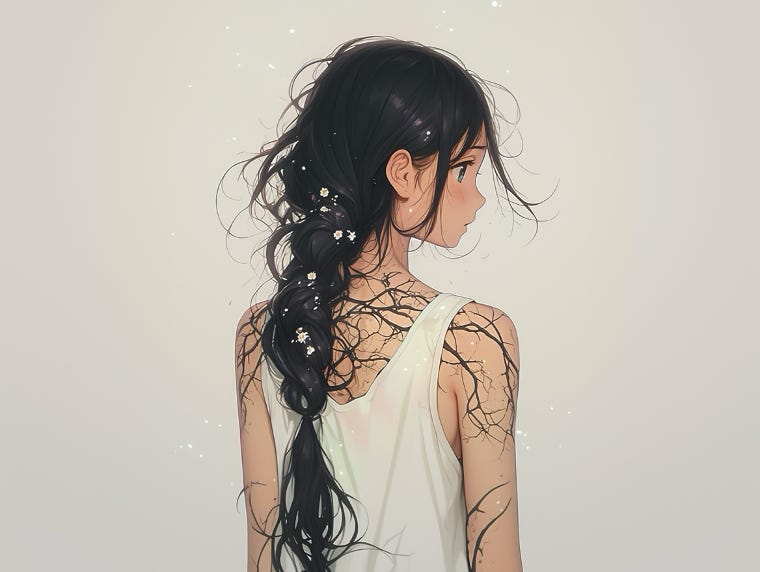
Once I’d calmed down, I realised it was a tattoo. I don’t have anything against tattoos, but I can’t say I like them either — they actually make me a bit uneasy. Not because I associate them with bad people, but because the idea of marking something foreign permanently into skin disturbs me. I’m uncomfortable if a stranger even brushes against me in the street. I snuck a look at the girl — petite, neither thin nor heavy, fair skin, almond eyes above her mask with no makeup, natural black hair pulled back in a ponytail, a plain white T-shirt and loose khaki trousers under a brown apron — completely not the type you’d expect to have that kind of bold, large-coverage tattoo. I quickly looked away and pretended to check my phone. When she brought the food over I finally got a proper look: her left arm was covered in a vine pattern, coiling around and around from the back of her hand all the way up into the sleeve.
After paying, I said: “Sorry about earlier.” She looked puzzled. I added: “Your arm — it’s really something.” She lifted her left arm slightly, turned it in the air, and her eyes creased — she seemed to smile behind her mask.
After that I went back often. Sometimes Maan was working, sometimes not. On the days she wasn’t there, I’d feel oddly flat. We never really talked; we weren’t even close to friends — just a nod back and forth, the same as any customer and server. But that tattooed arm fascinated and unsettled me at once. She knew I was watching, but she deliberately acted unbothered — kept using her left arm to carry menus, serve food, wipe tables, or clasped it behind her back when she had nothing to do, turning her back to me. But most of the time the vine-covered arm was either moving or too far away; I only got a brief look when she brought food or collected payment, and even then shyness stopped me from staring.
Until one day — I’d just paid and was about to leave when Maan suddenly said: “Do you actually like it?” Before I could react, she took my right wrist in her left hand. The grip was light, just her fingers and palm testing the contact. My wrist felt a flash of burning heat, almost like pain; before I could pull away, Maan let go. I couldn’t see her expression behind the mask, just her eyes, lowered, a little unsteady.
That evening, I noticed a tiny blue-green dot between my right hand and wrist — it wouldn’t wash off no matter how much hand wash I used. The next morning it had grown into a thin line wrapping once around my wrist, like a watchband. I quickly put on a long-sleeved jacket to cover it and went to the restaurant for lunch as usual, but Maan wasn’t in. Over the following week, the vines kept growing up my right arm until they reached my armpit, but Maan was nowhere to be found. On the seventh day, I asked the other staff where the girl with the tattoos had gone. They said she’d quit. I pressed for her contact, but the manager said she couldn’t share it.
Soon the vines had spread tight across my right shoulder, right back, and right chest — but they were smooth to the touch, like nothing was there. I examined every detail, heart in my throat. The blue-green lines were dense in some places, flowing in others, and somehow made my usually pale skin and weak arms look fuller, more alive. But they also felt completely at odds with my own body — like something foreign grafted on. The vigorous vines seemed to want to cover me, consume me, replace me with something new. Looking in the mirror, I realised with a shock: I had become Maan.
I knew I couldn’t escape it. I went back to the restaurant and said to the manager: “Are you hiring? I’d like to work here.” The manager didn’t seem at all surprised, as if she’d been expecting me. She led me to the break room, handed me a brown apron, and I took off my long-sleeved jacket to reveal the right arm covered in vines under my short-sleeved T-shirt. Without a word, the manager unbuttoned her shirt and showed me a purple rose on her chest. Later, the other staff revealed a chrysanthemum on one woman’s back, a sunflower on another’s stomach, and lilies on a third’s thighs. Everyone had their own secret mark.
A month later, the vines had climbed up my neck and onto my right cheek, crossing my shoulder and curling down my left arm — a T-shirt could no longer hide the truth. The manager received complaint after complaint from customers: this kind of girl shouldn’t be hired; the tattoos scared children; the staff’s appearance put people off their food. When I heard things like that, I’d slip into the break room and cry quietly. I didn’t even know why I’d come here to take this kind of abuse. But I felt bound and drawn to it, completely unable to help myself.
Then Maan suddenly reappeared. At first I didn’t recognise her. She’d let her hair down, wasn’t wearing a mask, had bare arms, and looked like the most ordinary girl imaginable. When I brought food to her table, she gently took hold of my right wrist and said: “I’m so sorry for the trouble I’ve caused you. I hated the vines before and wanted to find someone else to carry them, but I really regret doing that. Will you give Maan back to me?” In that moment, all the hurt and fear and resentment I’d been carrying came out in tears.
Back home, I stood in front of the mirror with my clothes off. The reflection was that hollow, barely-there body, weak and colourless. I expected to feel relieved, but all I felt was a strange, formless sadness. Then I noticed something: on the left side of my chest, a tiny shoot had appeared.
This time, I’m not afraid.
SF’s Strange Ordinary was originally published in Chinese in ebook format in 2025. Following it’s serialization in English translation, an English ebook version will be published. If you want to buy the Chinese version (USD 7.99), please click the link below:
Translated from the Chinese original with Claude
Picture generated with Midjourney


