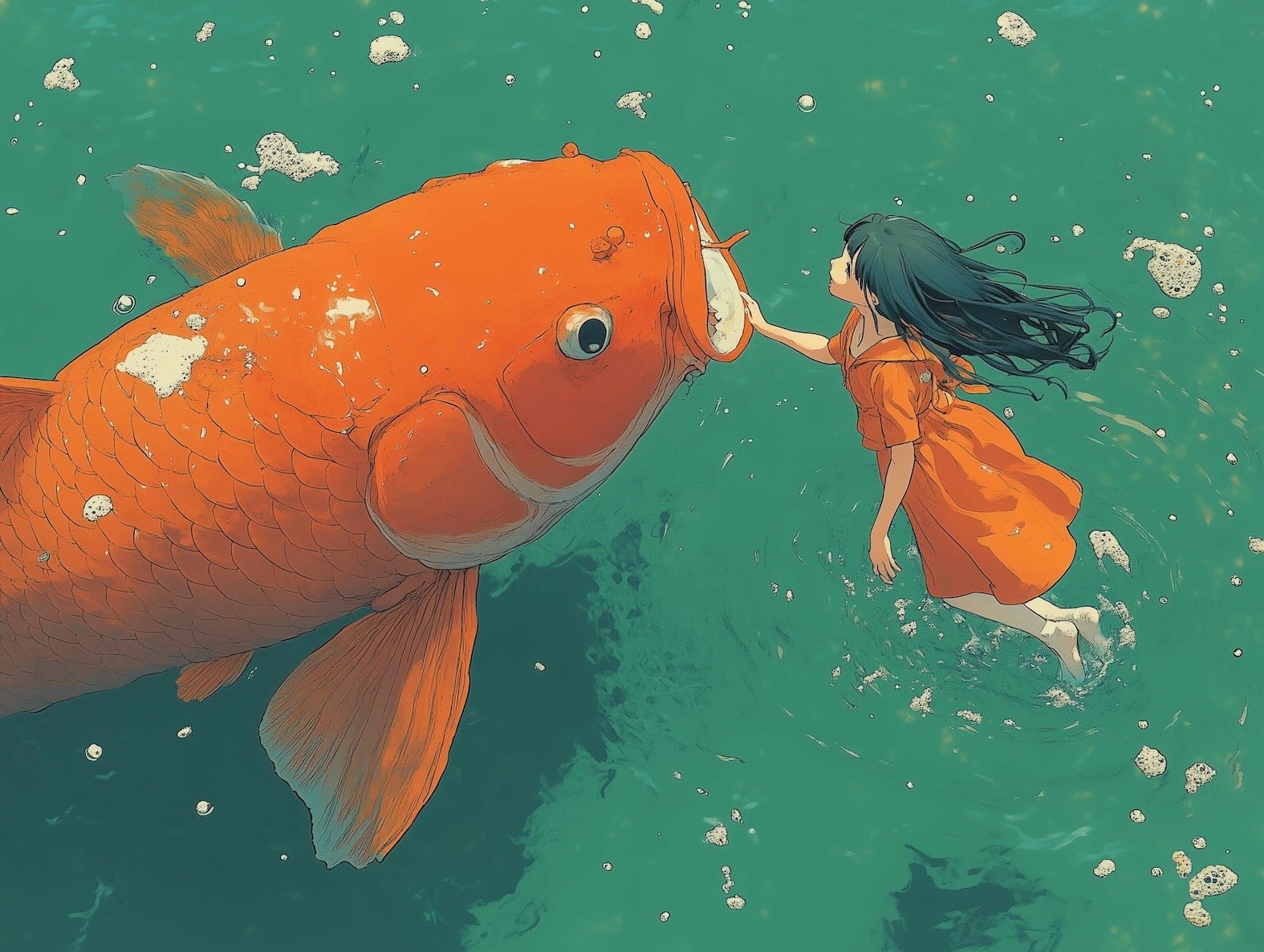
Her name wasn’t Lei, but her real name has been eaten, ___ rather than leaving gaps every time I mention her, I’ll use Lei to refer to her.
I had just started ___, could make no friends, and spent every ___ alone in the library. One dusk I came out and walked along the pond’s bank toward the train station. On the bridge I spotted a group of koi swimming leisurely below, and leaned on the railing to ___ for a while. Koi gather where people feed them, ___ and closing their ___— like black holes ___ and shutting — which is a little unsettling. I was __ to leave when I noticed someone not far away also leaning on the railing, ___ the fish.
She was a woman, more mature-looking than me — probably older. She ___: “Can you guess why those fish keep ___ their ___?” I was caught off guard and took a moment before ___: “They’re hungry?” She pressed her lips together, disagreed, and ___: “They want to talk.” “Talk?” I ___. “Fish can’t talk.” She ___: “Fish want to talk, but the words won’t come out. Who doesn’t want to talk? Anything ___ life wants to talk.” I disagreed: “I can go a whole ___ without talking, even a whole week, and I’m fine. Why do we need to talk? Is there anyone worth talking to? Isn’t it better not to?” She laughed and ___: “Aren’t you the one talking a lot right now?” Caught, I had nothing to ___ — and she ___, in a voice like rippling ___: “You must want someone to talk to after all. You can talk to me! I ___ talking. But I have one condition: after each conversation, you have to give me a word to eat.” I didn’t understand. She smiled and ___: “Just think of me as a word-eater.”
That ___ I talked ___ Lei until after dark. At the end she asked for a word; since I wasn’t sure how it worked, she ___: “Just give me something you won’t miss — a particle or filler word.” I gave her the character ___ (a written equivalent of the spoken particle ___). She told me to press against my chest ___ my ___, pull it out, hold it on my palm, and she picked it up ___ her ___ and put it in her ___, chewing as if it were something delicious before swallowing. I thought it was a funny game — until I discovered that afterwards, in speech and writing, I no longer had access to that character. It didn’t affect meaning, but it removed a tone, a nuance. For someone already flat and affectless in conversation, I became even more wooden.
Even ___, I kept coming ___ to the pond’s bank to talk with Lei whenever I could. I don’t know what it was, but as soon as I saw her I became a different person — no longer the quiet, wooden girl, but chattering freely, talking ___ everything and nothing, pouring it all out. And Lei listened with close attention, and at the end she ate the word I gave her with obvious satisfaction. At first she accepted less common words, but her requests gradually escalated. She ___: “I’m not picky, but if you keep ___ me words that don’t really matter to you, that’s not very generous of you.” I felt she had a point, ___ I pulled out the common conjunction ___ as a sign of good faith. She ate ___ with great pleasure and declared it especially delicious.
The way Lei savoured a good word made me keep offering more. Our conversations brought me more and more comfort. But my word-stock was shrinking. I concentrated on non-essential adjectives. Soon I could no longer say this dress is very ___, this cake is very ___, this flower is very ___, this person is very ___. This was manageable — some meanings could be expressed indirectly, through comparison. It was a test of my language skills.
Then Lei ___: “Names would be nice too.” Nouns are endless; there should be no shortage of ones I’d be willing to give. But I couldn’t feed Lei rubbish. I chose the nouns I treasured most — abstract values, concrete things. (Forgive me for not listing them; the relevant words have been eaten.) Lei isn’t greedy or unreasonable — she was careful ___ my interests, declined pronouns, and refused function words, ___ I could still form logical sentences. (Time, ___, cause and effect, relations — those she left alone.) I learned to find words that were meaningful, that tasted good to her, but that I could also express other ways. ___ as you read this now, you probably won’t notice how impoverished my vocabulary has become.
I won’t claim that many words are superfluous and forgettable. The opposite — exchanging them with Lei showed me how precious each lost word is. And this is something you only know after you’ve lost it. When there’s a word you can never ___ again, you finally understand its value. The ___ is, words you can no longer ___ gradually fade from ___, until it’s as if they never existed — and the value you understood becomes moot. In the end, I don’t know what I’ve lost. And the dilemma, such as it was, resolves itself.
What Lei really wanted was verbs. As a connoisseur of words, she considered verbs the most alive, most vigorous thing there is. Nouns are ingredients, adjectives are seasoning, function words are steps and matching — but verbs are the cooking itself. Without verbs, language is dead; not even worth arguing ___ on paper. I offered Lei everything I was willing to do for her, all of it expressed through verbs, for her to eat one by one — until I could barely move, could perform almost no action. In language, I was paralysed.
Winter turned to spring; the lotus in the pond was beginning to ___, and the koi were lively, leaping out of the ___ surface. I talked with Lei on the bridge once more, then pressed my chest and drew out the most important word I’d been holding there all along. It was the ultimate action-word of emotional declaration. Lei’s face lit up. She took it carefully, placed it in her ___, and tasted it slowly, a look of happiness on her face. I didn’t realise until then that the word was also Lei’s original name — a noun.
___ ate herself and vanished, and I was left unable to ___ anyone. I have only broken, incomplete words remaining. Some sentences I can no longer ___ at all. Though probably no one will notice.
SF’s Strange Ordinary was originally published in Chinese in ebook format in 2025. Following it’s serialization in English translation, an English ebook version will be published. If you want to buy the Chinese version (USD 7.99), please click the link below:
Translated from the Chinese original with Claude
Picture generated with Midjourney


