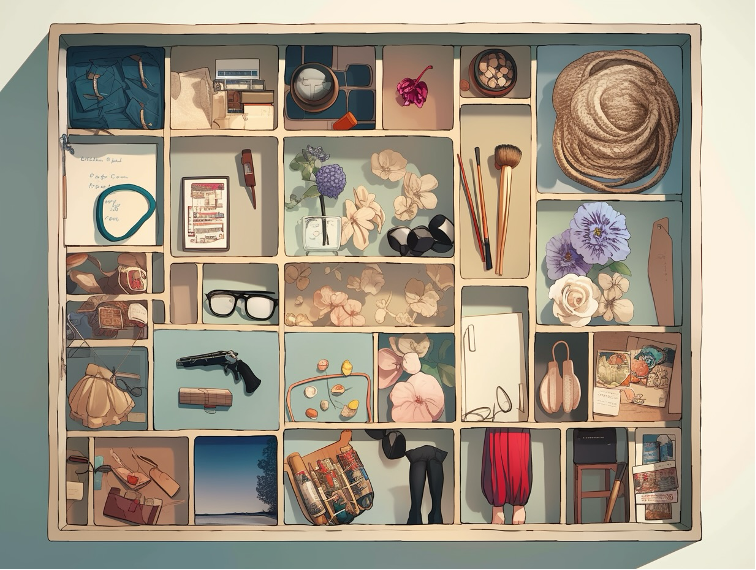
The first time I noticed Jok was on a warm evening. I was sitting at my desk by the window reading, when I casually pushed back a strand of hair. The clip near my temple slipped loose, bounced lightly off the desk, and disappeared from sight. I crouched down and searched every corner of the floor — nothing. At the exact moment the clip vanished, I heard a small, distinct sound: jok.
Things going missing near me wasn’t new. Before, it had always been small, forgettable stuff — paperclips, coins, little stickers. I’d assumed they rolled under the bed and didn’t think much of it. This hair clip wasn’t valuable, but my friend Siu-chai had given it to me — a matching pair, one with a tiny fox, one with a hedgehog. Now the fox was gone and I was left with only the hedgehog, which I couldn’t just let go. I searched hard, but there was simply nothing to find. That was the first time I knew Jok existed.
I called it Jok because I didn’t have better words for it. The closest description would be an invisible hole, but since you can’t see it, there’s no way to prove it’s actually a hole and not something else entirely. All I had was that faint but unmistakable little sound things made when they disappeared, so that became its name. More precisely, the sound is close to the English word “joke” — in Chinese, 足 (jok) is the nearest approximation. Don’t read anything into the literal meaning, though. Think of it as one of those specific notification sounds on a phone.
At first I thought Jok was somewhere in my room, maybe around my desk. I tried sweeping things off the tabletop to see if they’d vanish — but they just fell on the floor. My dad walked past the doorway, saw me doing this, and nearly had a heart attack thinking I was having an episode. Later I figured out that Jok could show up anywhere, not just at home.
One cool afternoon, I wore my favourite pale-green jumper to my part-time shift at the café. Changing into my apron, I pulled the jumper off too hard and the top button flew off — and before it could even hit the ground, jok, it was gone. I couldn’t help crying out. My coworkers came running and we all searched the floor together, but I already knew it was pointless. The button had fallen into Jok. I obviously couldn’t say that out loud.
That jumper was one I’d bought with A-loi. He’d said it looked great on me — natural, he called it. Now there was a missing button right at the front, and there was no replacing it. I started to feel properly annoyed at Jok, like it was taking things from me on purpose. But I couldn’t see where it was, couldn’t prevent it, let alone get back at it. I felt hard done by, and went to complain to A-loi.
A-loi is the only person I can tell these weird things to. Maybe because he’s a bit weird himself, he never questions me. He thought Jok didn’t mean any harm — it just existed, like a hole in the ground. If something falls in, that’s not the hole’s fault. He quickly added: “And of course not your fault either. Just bad luck. All you can do is be careful.” Whether that counts as useful advice, I wasn’t sure.
I didn’t really hate Jok, and I wasn’t scared of it. It was more like a low-level annoyance. The problem wasn’t just that things kept disappearing — it was that Jok was a constant reminder that I’m clumsy. That was the really irritating part. It felt like it was mocking me: can you not hold onto anything? And when I realised Jok wasn’t fixed to one spot but followed me everywhere — or more accurately, was always right there beside me — I had to admit that I might be the reason it existed at all. Jok had come into being because of me. That thought was a bit depressing.
For a while I was constantly anxious about important things falling in — my phone, books, wallet. I even worried that I might fall through myself and disappear completely. But over time it became clear that Jok had a limited size. At most, it was about the size of one of those big Kyoho grapes. (Which, yes — one day I was eating grapes my dad had bought, and I fumbled one right off the edge of the table. Gone. The equivalent of wasting ten dollars, and I felt every cent of it.)
Once I confirmed Jok couldn’t swallow anything bigger than a fist, I worked up the nerve to try mapping it out. Based on what had disappeared, I figured it hovered within about two feet of my body, somewhere between chest and waist height. Sometimes I’d toss something small in different directions to try to hit it. Sometimes I’d spread my arms and turn in circles, blindly feeling for something invisible in the air. But every time I imagined what might happen if my fingers went inside, I yanked my hands back and clutched them to my chest. Maybe, I thought, the human body just can’t pass through Jok.
The loss I regret the most: I got in the shower one day and forgot to take off the necklace my mum had left behind. While soaping up, I accidentally caught the chain; the pearl on the pendant came free. Over the sound of the water I heard that telltale jok, and my stomach dropped. I reached up — the pearl was gone. I turned off the shower and crouched in the bathtub looking for it, even though I already knew.
I put on my robe, hair still dripping, and went to my dad with a stricken face. I told him the pearl from Mum’s necklace had fallen off in the shower. He went straight to the bathroom, found nothing, of course. I told him honestly: “It had gone into Jok. Not just the pearl — lots of things near me had been disappearing into it.” My dad, to his credit, listened calmly without questioning or arguing. He just frowned a little and nodded.
That necklace was a gift Dad had given Mum shortly after they got married. After she was gone, he’d kept it put away, and only brought it out recently for my birthday, saying it would look nice on me. And now I’d lost this piece of her. I was crying and blaming myself when Dad said: “Maybe these things aren’t really lost. Maybe Jok is keeping them safe for you — putting them somewhere no one else can touch. They’re still right beside you. They haven’t actually gone anywhere. That’s what Jok means, isn’t it?”
How do you not laugh through your tears when someone says something like that?
SF’s Strange Ordinary was originally published in Chinese in ebook format in 2025. Following it’s serialization in English translation, an English ebook version will be published. If you want to buy the Chinese version (USD 7.99), please click the link below:
Translated from the Chinese original with Claude
Picture generated with Midjourney


