For a while, I wasn’t doing well mentally and was spending most of my time at home recovering. Every day my dad would nudge me to go for a walk in the nearby park, saying it would be good for me. At first I didn’t want to go — I’d wander around half-heartedly and come back feeling no better. It was always either too cold or too hot outside, and I’d rather stay home and read. That was until one day, in the children’s playground at the park, I came across Duk.
The first time I spotted Duk was probably a lot like how other people might spot a squirrel. A quick glimpse of something moving in the bushes, stopping to look — and then it’s gone. Then catching it again somewhere else, stopping to follow it, pulling out your phone to take a photo. Except I didn’t take out my phone to photograph Duk. The thought never even crossed my mind. And anyway, it wouldn’t have been possible. Why? Because anything that could be photographed wouldn’t be Duk.
The children’s playground was tucked in a corner of the park — small and a bit run-down, just two swings, a little slide, and a low climbing frame. Parents rarely brought their kids there. Duk was crouched beneath the slide, which had faded from its original bright yellow, completely still — almost camouflaged. If a gust of wind hadn’t suddenly made it shudder, I wouldn’t have known it was right there in front of me. I was genuinely startled in that moment. Not scared, just caught off guard — like discovering that something in a world I thought had nothing to do with me was actually looking back at me. Duk seemed just as shy as I was. It held still for a few seconds, then slipped behind the slide. I went around to the back — but Duk was already gone.
After that, I kept catching glimpses of Duk around the park. It didn’t stay in the playground; it moved around like it was playing hide-and-seek, ducking away in all directions. Most of the time I couldn’t find it, but I had a strong feeling it was secretly following me — because even when I couldn’t see Duk, I could sense it nearby. Sometimes I wouldn’t bother looking. That half-close, half-distant dynamic was just how things were between us. The most memorable time was a rainy day when I found Duk huddled inside a hollow in a tree. I didn’t disturb it, just nodded quietly in its direction. Apparently it hated rain just as much as I did.
By now you’ve probably guessed roughly how big Duk is. But please don’t picture a squirrel, or a kitten, or a puppy. Duk isn’t that kind of animal. If I had to say, Duk is closer to a small child in size. But I can’t describe what Duk looks like, because any description involves categorising it — and Duk is its own thing entirely, like nothing else in the world. Genuinely one of a kind. Sorry, I’m not great at philosophical definitions. The point is: Duk is just Duk. There’s nothing more to say.
At first I assumed Duk lived in the park, but then I started spotting it in other places too. Once, on the train into the city for a follow-up appointment, I saw Duk crouched in the connecting joint between two carriages, swaying gently among the shifting passengers. I noticed then that Duk was soft — flexible, almost elastic — not sharp-edged the way its name might suggest. But by the time I got off the train, it had vanished again.
The other times I ran into Duk outside the neighbourhood were on MTR escalators, in station corridors, and inside lifts — all crowded, busy places that didn’t suit Duk’s nature at all. Duk in those settings looked more withdrawn than Duk in the park, more isolated. I didn’t know whether it had followed me in from the suburbs, or whether it had always moved around to different places. Either way, it never interacted with its surroundings. So did that mean Duk and I actually interacted?
As I slowly got better, I started going out a little more — seeing friends, having meals, chatting. But it always felt like I was performing normality rather than actually living it. I noticed that Duk would show up nearby every time I had plans: sometimes just outside the restaurant, sometimes beside the table, but only for a moment before disappearing. It kept pulling my attention away so I couldn’t focus on the conversation. My friends were understanding about my situation and didn’t ask too much of me. I didn’t know whether Duk appearing was a coincidence or whether it meant something, but I couldn’t exactly ask it. And I knew I shouldn’t ask, because it was Duk.
One time I went to a birthday party for my university classmate Siu-meii, and only when I got there did I realise it was at a board game café. I was hopeless at games to begin with, and with my brain not working properly I lost at everything spectacularly. The guy sitting next to me was very patient and kept giving me hints. I didn’t recognise him — turned out he wasn’t from our department, just a friend of Siu-mei’s. Nobody brought up the fact that I hadn’t graduated yet; they just kept the conversation light and fun. The noise of everyone laughing was starting to make my head swim — and then I saw Duk hop up onto the table and knock over a wobbly tower of blocks. Everyone laughed and said: “Sun-fei, you lost again! You have to drink this whole bottle of beer!” The guy next to me immediately grabbed the bottle and poured it down his own throat.
The party ended late. The guy offered to walk me home, and I didn’t mind, so I let him take the train with me. On the way I asked if he’d ever seen Duk. He asked what Duk was. I thought about it, decided it was too hard to explain, and pointed at one of the hanging straps on the handrail instead. I said: “See for yourself — Duk is right there.” The strap was swinging, just like Duk playing on a climbing frame. The guy only walked me as far as the Fanling station gates before saying he had somewhere to be and heading off.
I walked home alone. Along the way I could hear Duk trailing behind me, sometimes close, sometimes further back. I turned around and spoke into the dark: “Why are you always following me? Why the sneaking around? You want to play, don’t you? Stop hiding! What do you want to play? Come on — I’ll play with you!”
Back home, I looked around for something to play with and found an old Go set. I remembered that before everything fell apart, Go was the one game I was actually good at. I asked Duk if it knew how to play Go. No answer. I asked whether it wanted black or white. No answer. I asked if it wanted to go first or second. No answer. So I picked up a black stone and placed it on the board with a sharp, clean click — duk — right on one of the intersections. I said: “Your turn.” Still no answer. I laughed and said: “You don’t need to think that long for your first move.”
After a long while, I picked up a white stone and placed it on another intersection. One black stone, one white stone, a space between them, facing each other. It was no longer Duk. Duk was gone.
SF’s Strange Ordinary was originally published in Chinese in ebook format in 2025. Following it’s serialization in English translation, an English ebook version will be published. If you want to buy the Chinese version (USD 7.99), please click the link below:
Translated from the Chinese original with Claude
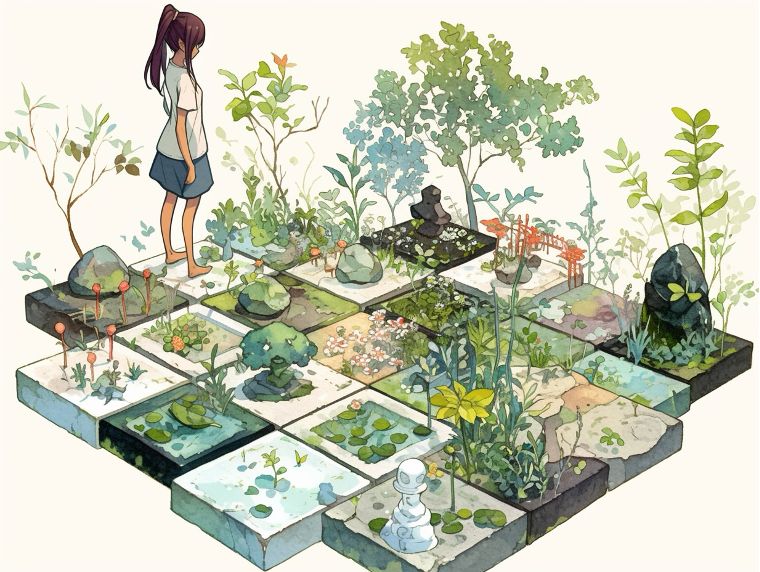
Picture generated with Midjourney


